
THE BUSINESS CASE FOR CULTURAL INTELLIGENCE
The compounding cost of organisational blind spots.
Executive Summary:
Absence, voluntary turnover, strained managers, and underperforming people spend do not happen by accident, and they never happen in isolation. Most leadership teams only see the commercial impact after the fact: in exit interviews, occupational health referrals, and fragmented consultant invoices.
Ampt connects the human and operational signals before they compound. This page outlines six key exposure areas, how targeted intelligence redirects misallocated spend, and what this unlocks for your bottom line.
Business case 01
Retention & voluntary departures
The hidden drag
When good people leave, the invoice is only part of the cost
A replacement invoice captures only a fraction of a departure. Institutional knowledge walks out the door. Colleagues absorb extra work while recruitment and onboarding draw heavily on management time. Delivery slows, collaboration strains, and the extra pressure on those who stay makes the next resignation more likely.
How connected intelligence changes the dynamic
Earlier visibility and shared agency
Ampt gives every level the context to act before departures become the only visible signal.
Managers rarely want to lose good people, but they are often operating blind until a resignation lands on their desk. Ampt provides clearer visibility into their team's cultural reality, showing where friction is compounding and where their management approach may need to adapt.
Employees receive private reflection tools that build personal agency, helping them understand their own strain, energy and work boundaries.
Leadership sees the structural pressures associated with turnover across divisions, creating a basis for executive action on systemic issues rather than relying on reactive exit interviews.
The commercial reality
Protecting capacity and institutional knowledge
For an organisation of 11,000 employees, moving annual turnover from 15% to 13% means 220 fewer departures. At £10,000 per replacement, that represents £2.2 million in avoided direct replacement costs. This sits alongside the operational value of retained expertise, protected team morale and uninterrupted client delivery.
Business case 02
Sickness & unplanned absence
The hidden drag
The absence figure counts missing days; the strain spreads much further
When someone is off, the work still needs doing. Colleagues take on additional demands, managers rearrange resources and projects experience delays. Repeated disruption gradually erodes the recovery time and resilience of the people providing cover, creating a compounding cycle of exhaustion across the wider team.
How connected intelligence changes the dynamic
Distinguishing workload from chronic depletion
Ampt examines absence alongside the daily working conditions experienced by teams.
Personal reflection reveals when recovery and energy are dipping, giving individuals the context to reset habits and seek support before acute fatigue becomes illness.
Managers gain a clearer view of short-term operational pressure and deeper, compounding exhaustion within team conditions, helping them adjust expectations and support people earlier.
Leadership moves beyond treating absence simply as an attendance metric. You see where burnout indicators cluster across functions and can direct preventative support before absence becomes chronic and entrenched.
The commercial reality
Restoring working capacity and reducing temporary cover
Across 11,000 employees averaging seven absence days annually, a 5% reduction restores 3,850 working days, representing £758,450 of employment-cost capacity. Any reduction in overtime, temporary cover or delayed delivery would be additional and should be modelled using the organisation's own operating data.
Business case 03
Change readiness & operational continuity
The hidden drag
Integration plans succeed or fail on the people carrying them
A major transformation, restructure or merger can hit its formal milestones on paper while delivery capacity collapses underneath. Uncertainty consumes focus. Shifting reporting lines unsettles trust. Managers are expected to protect business-as-usual delivery while learning how unfamiliar teams operate under stress.
How connected intelligence changes the dynamic
Current signals during critical transitions
Ampt establishes how affected teams are experiencing the transition as it unfolds.
Provides a private, grounded space during periods of flux, helping individuals maintain personal perspective, resilience and clarity of role.
Gives leaders of newly formed or restructured teams insight into team fault lines, highlighting where friction is compounding so they can address conflicting priorities earlier.
Integration executives can distinguish departments drawing on strong resilience from those carrying concentrated pressure, creating a reliable basis for targeted support and strategic intervention.
The commercial reality
Protecting revenue and delivery during critical windows
For a business unit contributing £10 million annually, approximately £2.74 million falls within a critical 100-day transition window. A 10% to 20% performance dip represents £274,000 to £548,000 of delivery exposure. Protecting five percentage points of that performance preserves roughly £137,000 in operational value.
Business case 04
Targeted management development & team performance
The hidden drag
Generic leadership courses and disconnected toolkits
Quality development programmes are valuable, but generic training rarely shifts the daily team reality managers return to. One team is wrestling with sustained workload, another has unspoken collaboration friction, and another is carrying hidden fatigue. Without visibility into what their team is experiencing, managers are left guessing while the underlying fault lines remain untouched.
How connected intelligence changes the dynamic
Practical growth for managers, targeted impact for L&D
Ampt does not discard your existing development resources. It connects them to live team reality.
Managers do not need to become wellbeing experts, counsellors or psychologists to lead high-performing teams. Team intelligence reveals blind spots, shows where friction is accumulating and provides focused adjustments they can apply in the flow of daily work.
By showing where cultural strain concentrates across departments, L&D and executive leaders can direct coaching, development and budgets where they address evidenced need rather than spreading spend evenly and hoping it lands.
The commercial reality
From tick-box compliance to a performance driver
Team-specific visibility gives managers a better chance to address friction early and adjust with confidence. Leadership development becomes connected to the conditions shaping collaboration, burnout risk, retention and capability, rather than operating as a separate programme.
Business case 05
Initiative effectiveness & targeted spend
The hidden drag
Expensive shelfware and calendar-driven fatigue
Wellbeing calendars and perk subscriptions have their place, but without individual context they rarely drive lasting behaviour change. Organisations move from one initiative to another hoping something sticks, while employees experience them as passive programmes pushed from above. Budgets are committed to generic solutions while the underlying drivers of strain and friction remain untouched.
How connected intelligence changes the dynamic
Agency for people, precision for leaders
Ampt does not replace your current wellbeing initiatives. It gives them context and traction.
Personal reflection shows where they sit across lifestyle, resilience and energy. Employees gain the context to reframe habits, choose where to focus and build genuine agency.
Leadership sees where friction is accumulating, which populations are affected and where existing support may have the greatest relevance. Investment can be directed with greater confidence rather than spread thinly across untargeted provision.
The commercial reality
From sunk cost to a more accountable performance investment
Direct existing investment towards evidenced pressure and capability needs. Ampt gives leadership a stronger basis for deciding which initiatives to protect, where provision needs to reach and what movement should be reviewed over subsequent cycles.
Business case 06
External consultancy & fragmented advice
The hidden drag
Disconnected diagnostics and expensive reactive reviews
Organisations frequently commission episodic external surveys or consultants when friction flares up. Each provider may look through a different lens: an engagement survey here, a psychosocial audit there, a leadership assessment elsewhere. Results arrive in separate reports, leaving leaders to reconcile fragmented evidence, competing recommendations and recurring fees without a continuous organisational view.
How connected intelligence changes the dynamic
An enduring organisational intelligence system
Ampt creates an integrated evidence foundation beneath specialist advice.
A consistent, lightweight reflection rhythm feeds into practical adjustments, creating continuity between review cycles rather than another point-in-time exercise.
A connected baseline across 21 domains can reduce duplicated diagnostics, give internal and external specialists a shared evidence base and help the organisation retain continuity between individual reviews or interventions.
The commercial reality
Sustainable intelligence over recurring advisory spend
Consolidating overlapping surveys, point-in-time audits and reactive consulting cycles can reduce duplicated advisory spend while keeping long-term ownership of cultural intelligence inside your organisation.
Give yourself a clearer basis for real change.
The first review cycle establishes your baseline conditions and equips your people to respond. Subsequent cycles show what has strengthened, where pressure persists, and how your priorities should evolve.
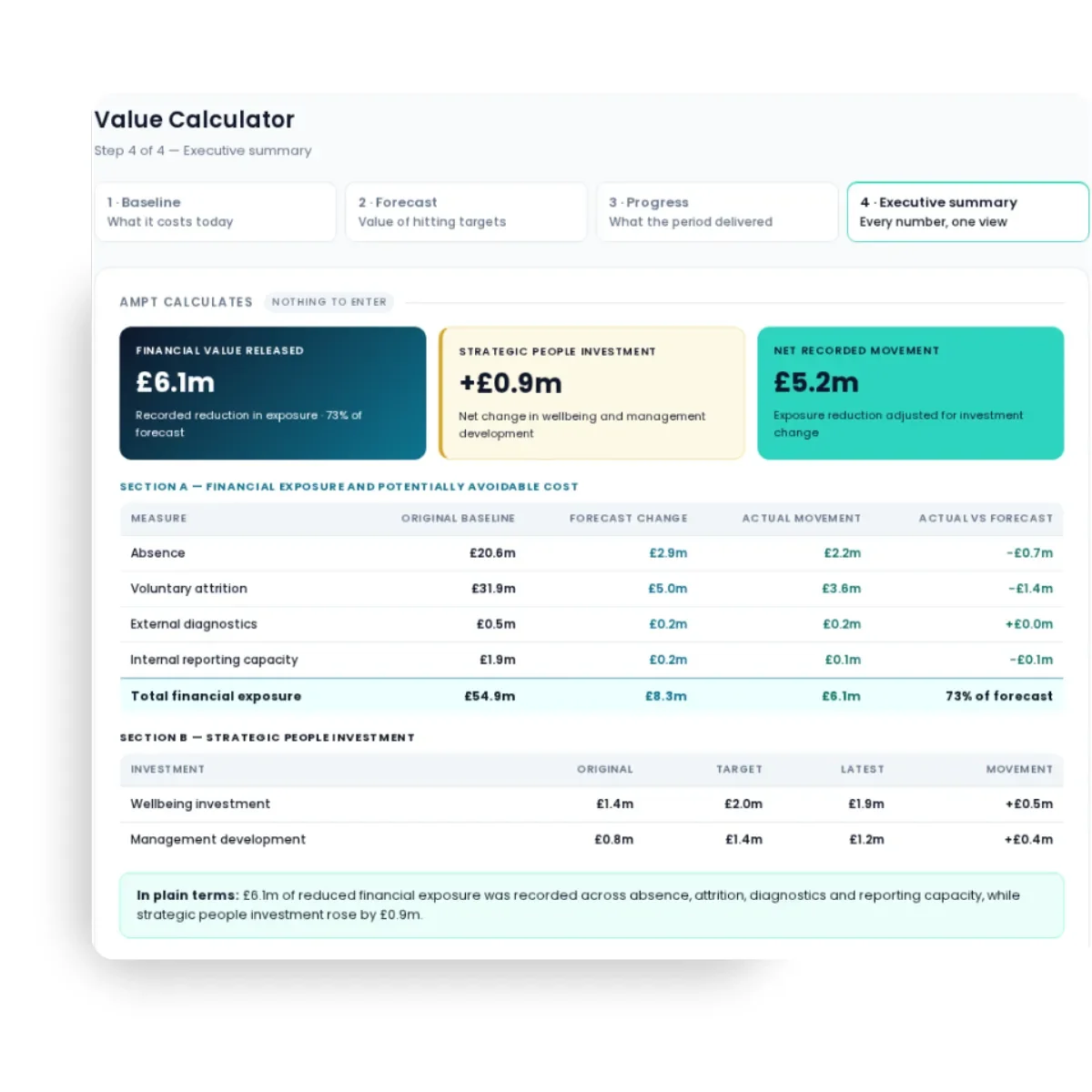
Model Your Exposure: Use your organisation's headcount and operating figures to see what unaddressed friction is currently costing your business.
Request a Working Walkthrough: A focused 20-minute review of the Culture Compass, master intelligence, and role-specific outputs.
HOW WE DO IT
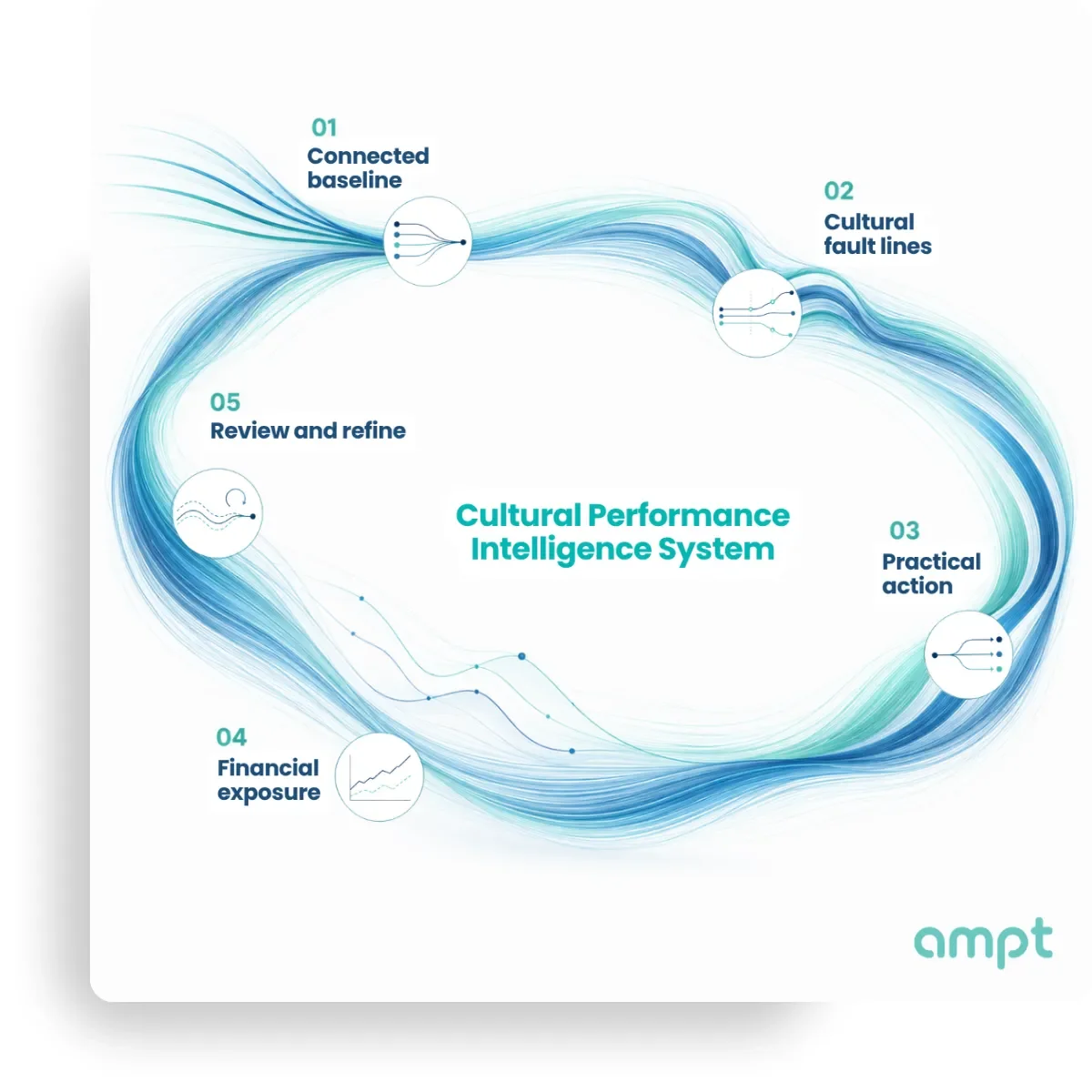
How cultural intelligence becomes business capability.
1. Establish the organisational cultural baseline (Benchmark)
Through 4 reflections we capture 21 key culture domains simultaneously, revealing patterns of strength, pressure and capability across your organisation and how they influence cultural health and team performance.
2. Surface cultural fault lines
Rather than treating culture as a single score, we identify where friction, unspoken strain and capability gaps cluster across teams, roles and sites.
3. Put practical clarity in every hand
Employees receive personal insight to build wellbeing. Managers receive team-specific actions. Leadership receives governance-grade priorities to direct resources where they count.
4. Model the operational exposure
We connect cultural friction directly to business costs, giving leadership clear financial context around absence risk, lost capacity and retention before decisions are made.
5. Compound progress cycle by cycle
We review conditions on a structured cadence, tracking what has shifted so your organisation sharpens its response and builds cumulative momentum over time.